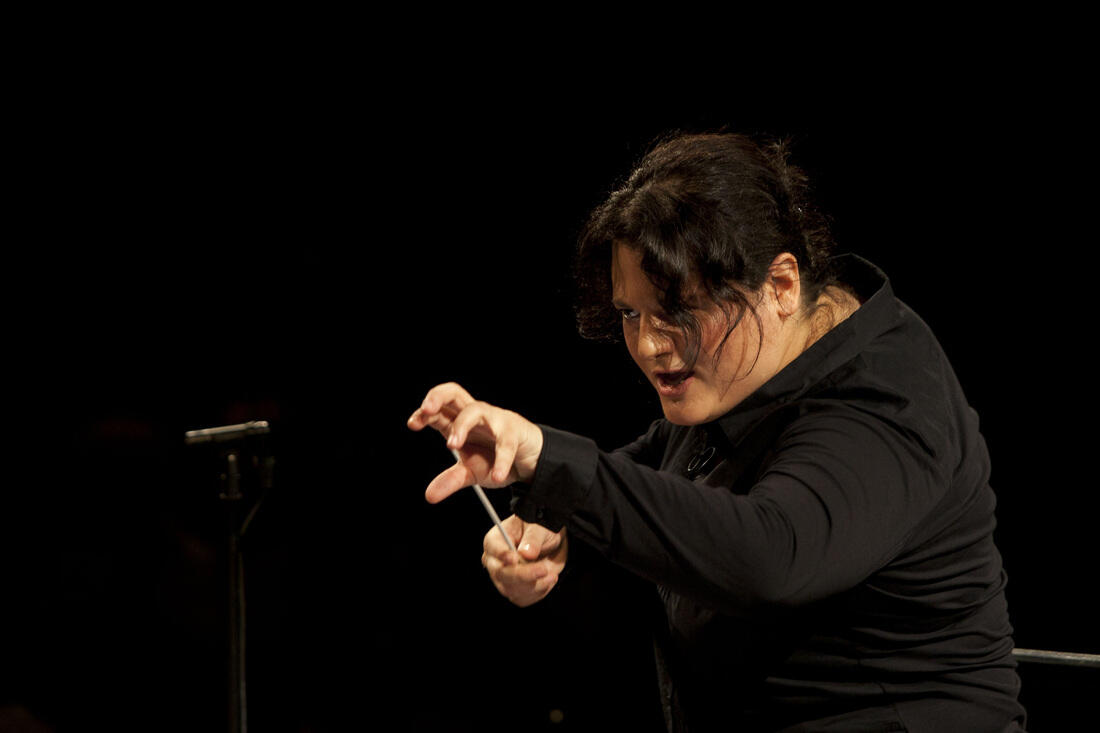
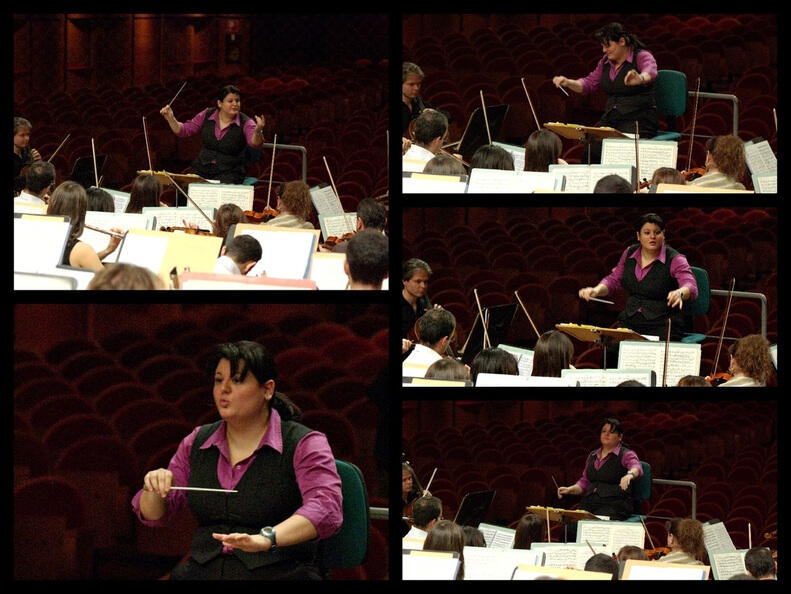
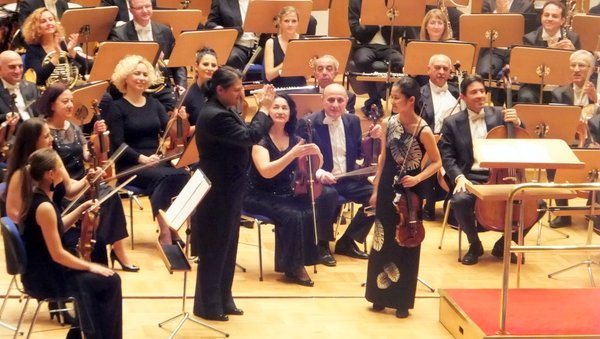
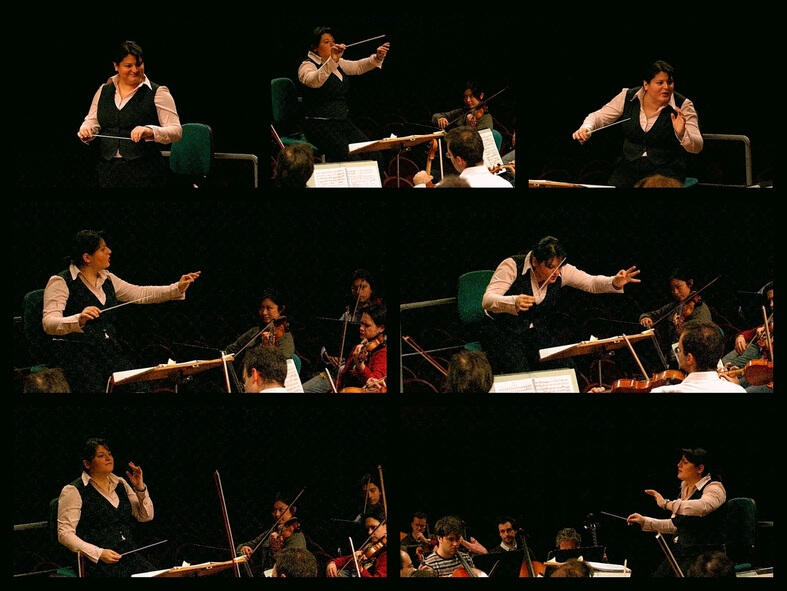
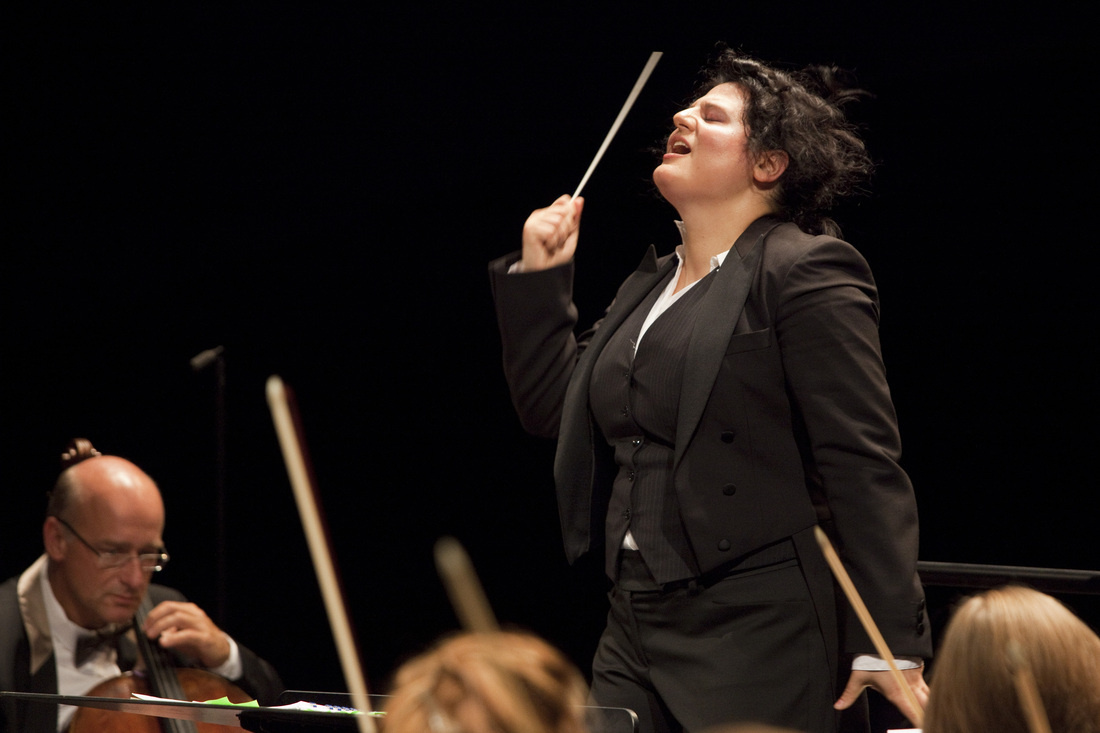
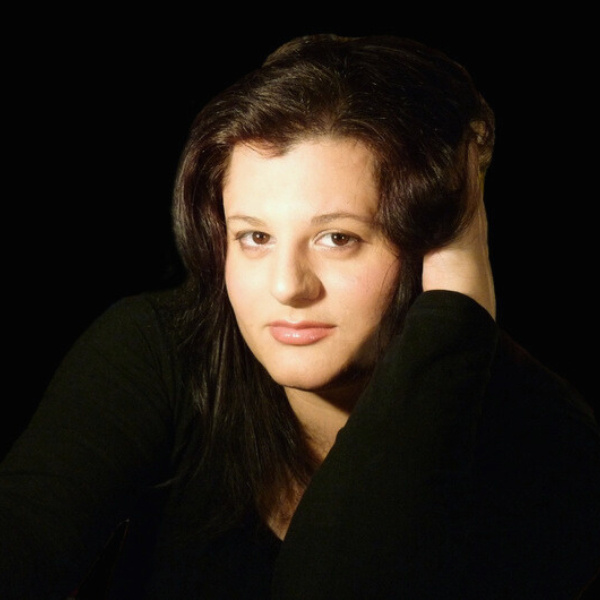
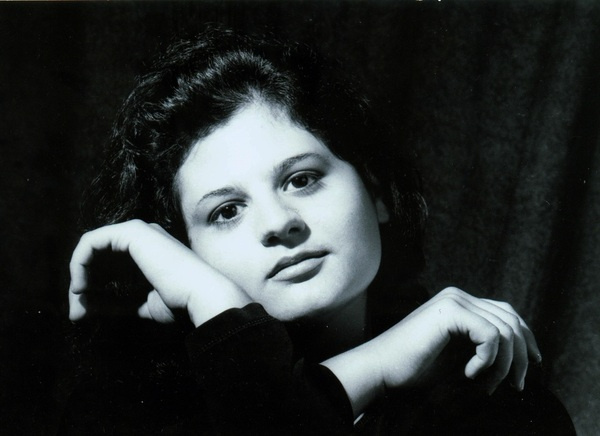
STAMATIA KARAMPINI
"The young conductor Stamatia Karampini performed Shostakovich´s 5th Symphony with an astonishing level of intensity and structure, exhibiting a profound knowledge of the work with a passion previously demonstrated by conductors of the caliber of Mravinski, Kondrachine, Ancerl, Sanderling, Bernstein and more recently, Haitink. From start to finish, she remained in complete control of the orchestra, wielding the baton with extraordinary precision - a phenomenal interpretation. The audience left the concert hall tonight with the impression that a new star had been born.”(Orchestre National de France)
Altamusica reviews
A BIOGRAPHY
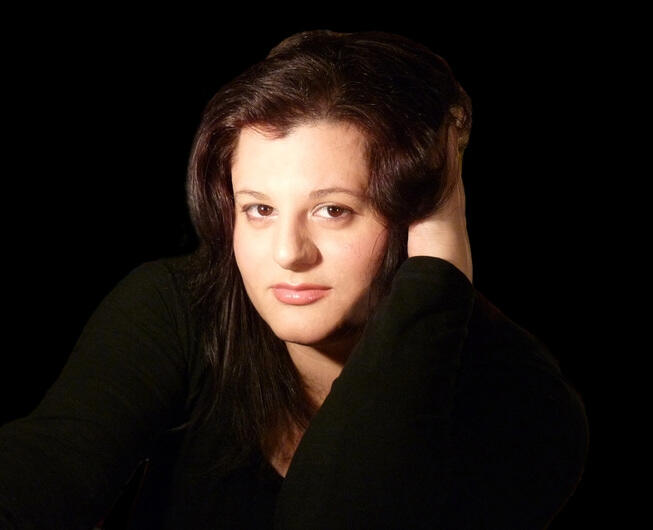
Born and raised in Greece, Stamatia Karampini grew up on the island of Crete and later in Thessaly. A pupil at the Municipal Conservatory of Larissa since the age of 5, she started playing the piano and eventually moved on to cello, specifically because she wished to play in an orchestra. She began conducting youth orchestras, ensembles and choirs at the early age of 13, when, during her school vacations, she would participate in international conducting master classes abroad.Stamatia officially studied Orchestra and Opera conducting under Prof. Hermann Michael at Munich's Hochschule für Musik und Theater. She graduated youngest in her class and with high honors, specializing in opera conducting. She went on to receive a master's degree from the same institution. After two more years as a student of Prof. Jorma Panula at the Royal Academy of Music in Stockholm, she received the postgraduate Diploma in conducting, specializing in music of the 18th, 19th and 20th century.At age 19, Stamatia won First Prize at the Alexandra Triantis conducting competition in Athens. She became a recipient of the Richard Wagner scholarship in Bayreuth. Since that time, she has won a variety of prizes at international conducting competitions such as the Nikolai Malko and the Dimitri Mitropoulos contests. As part of St. Petersburg's 300th anniversary celebrations, Stamatia received an honorary degree from the Prokofiev Organization for her exceptional performances of Prokofiev's works with the St. Petersburg Philharmonic.Maestro Zubin Mehta has called her "one to watch". Hermann Michael referred to her as "possibly the most impressivSNAe conductor after Mitropoulos to emerge from Greece". Famous Italian author Quirino Principe wrote an essay dedicated to her
( "...this young woman´s life is a rare example of artistic asceticism; leading a life entirely dedicated to music and marked by countless sacrifices...").When Stamatia Karampini was 25, she received a personal invitation from Kurt Masur to share the podium with him in collaboration with the Orchestre National de France. She rose to the task with tremendous success. As the Altamusica review noted: “The young Greek conductor Stamatia Karampini performed Shostakovich´s 5th Symphony with an astonishing level of intensity and structure, exhibiting a profound knowledge of the work with a passion previously demonstrated by conductors of the caliber of Mravinski, Kondrachine, Ancerl, Sanderling, Bernstein and more recently, Haitink. From start to finish, she remained in complete control of the orchestra, wielding the baton with extraordinary precision--a phenomenal interpretation. The audience left the concert hall tonight with the impression that a new star had been born”.Stamatia Karampini garnered more public attention after her memorable participation at the international conducting competition in Besançon where she won the "Prix du Public". The audience´s reaction was described in the press the next day as follows: "During the final performances the Greek candidate maintained her undeniable charisma, her unique gestures and a close intimate communication with the orchestra musicians. As the only one of the finalists to conduct by heart she gave the most personal interpretation of Don Juan. The audience exploded in applause, many of them standing, a reaction appropriate to a passionate interpretation and demonstration of a deep understanding of the musical material."As a finalist in the Donatella Flick competition, she stood in front of the London Symphony Orchestra, conducting Debussy´s "La Mer" and Prokofiev's suite to "Romeo and Juliette". A 25-minute documentary about the Greek conductor, titled “Young Conductors of Tomorrow”, was broadcasted on the cultural channel ARTE for French and German television.Stamatia Karampini has been in charge of various operatic productions, such as Verdi's “Un Ballo in Maschera” at the State opera in Frankfurt, and Strauss's "Die Fledermaus" at the Komische Oper Berlin. Karampini conducted and has taught at the US Jacobs School of Music. She has collaborated with renowned musicians like Maxim Vengerov, Bertrand Chamayou, Antoine Tamestit, Alison Balsom and Sayaka Shoji, to name a few.Her previous engagements included concerts with the Brussels Philharmonic, the Würth Philharmonic orchestra, the Barcelona Symphony orchestra, the Staatstheater Darmstadt and Frankfurt, the London Philharmonic Orchestra, the BBC Philharmonic, the Düsseldorf Symphony Orchestra, the Orchestra and Choir Giuseppe Verdi in Milan, the St. Petersburg Philharmonic Orchestra, the Orchestre de Chambre de Lausanne, and the Orchestre National de France.In these and many other venues, she has proven her remarkable range, spanning the German and Viennese Schools of Beethoven, Bruckner, Mahler, Brahms and Richard Strauss, as well as the music of Bartók, Liszt, Debussy, Sibelius, Ravel, Stravinsky, Prokofiev, Tchaikovsky, Rachmaninoff, Scriabin and Shostakovich. She has a rich operatic repertoire and often conducts the first performance of contemporary pieces.
Send us your message here:
REVIEWS
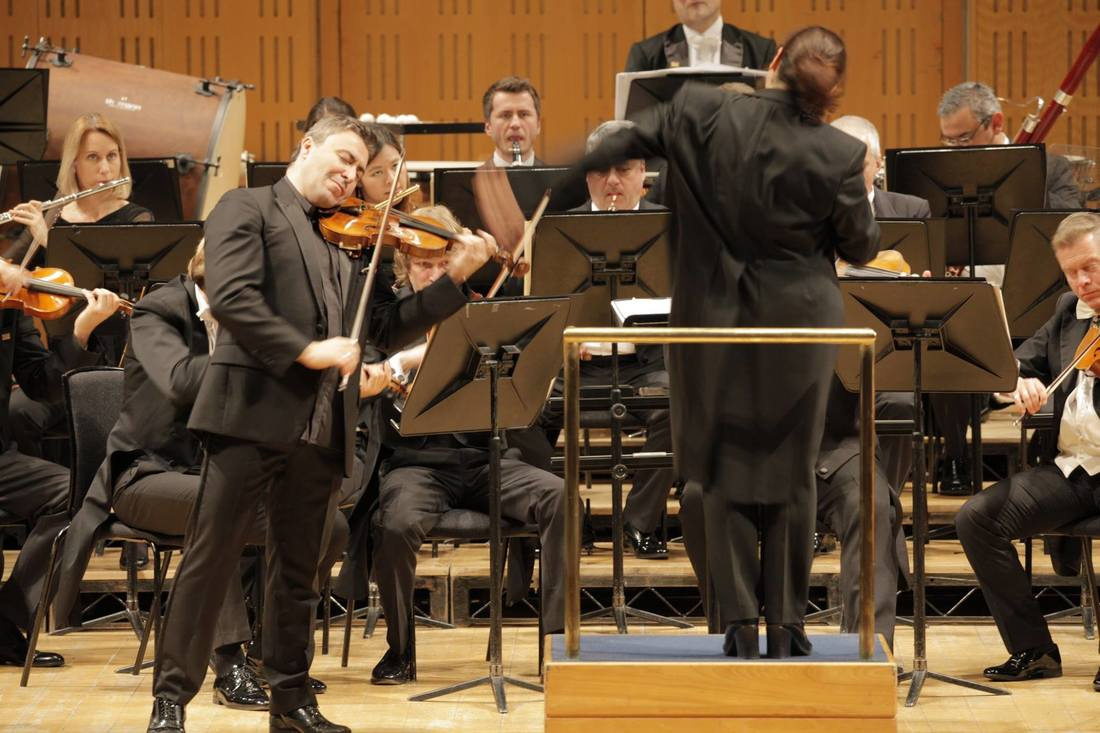
"Stamatia Karampini conducted the first half ( Vengerov the 2nd). It got off to a rousing start with the overture to Johann Strauss's Die Fledermaus, its exuberance well-served. Max Bruch's G minor Violin Concerto was given an expansive outing, somewhere between leisurely and grandiose and grew in stature. " David Truslove, The Anvil
classicalsource"It was immediately clear that the programme was extremely well rehearsed, and the young players made a spectacular showing from the very beginning.The Strauss overture received precise and idiomatic playing, with a proper sense of 'Viennese lilt' which at the same time never became an excuse for the rhythmically slovenly delivery which we can sometimes encounter in Strauss. The applause at the end was much more than conventionally polite."
Paul Corfield Godfrey
seenandheard-interational.com" In the Strauss Overture, there was a beautiful clarity in the intonation, and a golden bloom in the violins, crystal clear in the winds allowing the orchestra to play with a panache and a style all well directed by the young Greek conductor Stamatia Karampini. The high level continued with the arrival of Maxim Vengerov for the Bruch G minor concerto, his mastery was apparent from the first notes despite some lack of accuracy in the brass, but Karampini soon restored the balance by giving the Siberian violinist marvelous accompaniment matching his every argument. The beauty continued with the Saint-Saens Introduction and Rondo Capriccioso. Impeccable and magical playing, this was as perfect a performance as one could wish for, in phrasing, music and harmony with great interplay with the orchestra/" Gregor Tassie" Under the confident baton of Stamatia Karampini, the Wuerth Philharmonic begin the afternoon gloriously with the Overture of J.Strauss Die Fledermaus, the smiles that apear instantaneously on the faces of the audience, testament to both the popularity of the piece and the virtuosity with which it is played by this stunning orchestra." Glasgow Theater" With considerably aplomb, the young Greek conductor Stamatia Karampini directed the two violin works as well as Johann Strauss' sparkling Fledermaus overture. Ms Karampini's musicianship is gaining increasing respect through her engagements with a number of prestigious European orchestras."
Pat O'Kelly"Karampini's shaping of the big Waltz tune captured that sometimes elusive Viennese lilt. The solo clarinet and oboe in the overture's wistful central section were exquisitely shaped by the Greek conductor. The cheers and bravos built up to a crescendo as the stocky black-suited figure of Maxim Vengerov carrying his gleaming 1020 ex-Kreutzer Stradivari appeared on stage." Geffrey Mogridge"Regarding the Sibelius Violin concerto, conductor Stamatia Karampini demonstrated a very high quality of sound management. In Schubert’s unfinished symphony, under Karampini’s leadership and very clear strokes, much attention to detail was paid, for the orchestra to obtain this memorable result of interpretation. We hope in the years to come even more Turkish orchestras to discover this unique conductor."
Reflections on the Arts
Sefik Kahramantkaptan"A very successful concert with guest conductor Stamatia Karampini. The conductor led the Staatsorchester Darmstadt lively and meticulously, creating so an interpretation that managed to rivet the audience´s attention all the way through the duration of this very complex, intricate music."
(On Wolfgang Rihm´s : "Nähe fern 3")
www.echo-online.de" Dvorak´s Serenade op.22 was played with a light and transparent sound, with occasional sharp accents and a sense of musical humour. Stamatia Karampini is a very promising conductor: the Vienna Chamber Orchestra was lead with an impressive ease, lightness and joyfulness in this interpretation..."
Neue Kronen Zeitung Vienna
by Florian Krenstetter"...The conductor Stamatia Karampini and the Orchestra partnered very well. The young Greek conductor made for an absolute highlight together with the excellently rehearsed Orchester des Musikkollegium Winterthur. Not only did she greatly impressed from the very beginning of the program, with Prokofiev´s Andante for Strings and the Suite from "Pelléas et Mélisande" by Sibelius, but her interpretation of the "Symphonie Classique" by Prokofiev was just tremendous. Her conducting style is light and sleek, elegant and clear. From her natural, harmonious movements pulsates the music, like a river. She doesn´t need grand effects, works with precision(...)placing attention to fine details and variation of sounds, she explored the individual voices and wove them together to a deliberate structure. This way, the popular "classical symphony" was a rare listening experience."
Der Zürcher Oberländer Zeitung
by Irène Maier"The multifaceted score was superbly performed under the expert guidance of conductor Stamatia Karampini, whose abilities were given plenty of opportunities to shine. The talented Maestra demonstrated a vibrant vigour, precision and musical depth, while at the same time always maintained excellent balance amongst Singers, Choir and Ensemble."
( on "Un Ballo in Maschera", Verdi)
by Gerhard Hoffmann
www.der-neue-merker.eu"In the 'Eighth'( Beethoven) Karampini phrased beautifully the first movement, singing phrases and emanating beauty. A scrumptious "Allegretto" was accomplished, with a great sense of rhythm and clear sound. This was a first time performance for the Barcelona Symphony Orchestra of the piece "Dona Nobis Pacem" by Vaughan Williams featuring the "Orfeo Català" choir; the interpretation was filled with attractive colours, great textures of its melodies and a lot of passion."
Barcelona
by Ablo Meledez-Haddad
www.abc.es"Stamatia Karampini refrained from special effects and focused on illustrating the complexity of the score. To do this, she managed to keep the Orchestra away from that lazy " porridge"-like sound , which always creeps in at a certain point in Brahms symphonies Stamatia Karampini achieved to avoid this, by prioritizing and maintaining a constant attention to the lucidity of the interpretation, which never sounded fake, overly sentimental or mawkish."
(on Brahms´s 3rd symphony)
by Frank Raudszus
www.egotrip.de"Particularly impressive was the Greek conductor Stamatia Karampini, a hardy young "Lady in Tails", who wasn´t intimidated by the savvy Düsseldorf Symphony Orchestra, but declared her desires in a gracious, albeit very precise way. There was a very powerful, non-sentimental reading of Mendelssohn's Symphony No. 4, the "Italian", in which the second movement sounded with an almost ruthless melancholy."
(The day after the unveiling of the Mendelssohn Monument)
Wolfram Goertz
Rheinische PostPlease find here an essay composed by author Quirino Principe with the title:" Lo stile di Stamatia Karampini""The young conductor Stamatia Karampini performed Shostakovich´s 5th Symphony with an astonishing level of intensity and structure, exhibiting a profound knowledge of the work with a passion previously demonstrated by conductors of the caliber of Mravinski, Kondrachine, Ancerl, Sanderling, Bernstein and more recently, Haitink. From start to finish, she remained in complete control of the orchestra, wielding the baton with extraordinary precision - a phenomenal interpretation. The audience left the concert hall tonight with the impression that a new star had been born”.
(Orchestre National de France)
by Michel Le Naour
Altamusica" During the final performances( of the conducting competition) the Greek candidate maintained her undeniable charisma, her unique gestures and a close intimate communication with the orchestra musicians. As the only one of the finalists to conduct by heart she gave the most personal interpretation of "Don Juan". She received the "Prix du Public". The audience exploded in applause, many of them standing, a reaction appropriate to a passionate interpretation and demonstration of a deep understanding of the musical material."
by Nicolas Mesnier-Nature
www.classiqueinfo.com


GALLERY